
r-2026-3
Risk of Pulmonary Diseases in Osteogenesis Imperfecta in
Denmark: A Register-Based Cohort Study
RCH 2025
https://academic.oup.com/jbmr/article/40/2/211/7922271
Outline
Tables (3)
Extras (1)
Referred to by
Carolyn Jordan Henderson, Burton L. Lesnick
CHEST, Volume 167, Issue 3, March 2025, Pages 645-646
Background
 Osteogenesis imperfecta (OI) is a rare hereditary disease mainly resulting in reduced or altered collagen type I. Collagen type I is a major constituent of the respiratory system, and normal collagen type I is vital for pulmonary tissue function.
Research Question
Do patients with OI have increased admission rates resulting from pulmonary diseases compared with the general population?
Study Design and Methods
This was a register-based nationwide cohort study including all patients with OI in Denmark and a reference population. From January 1, 1995, through December 31, 2018, we evaluated the rates of admissions resulting from asthma, COPD, and pneumonia as well as the use of bronchodilator drugs and antibiotics comparing individuals with OI with the reference population.
Results
We included 862 individuals with OI and 4,283 people from the reference population covering 15,952 and 79,471 person-years of observation, respectively, in the two cohorts. The admissions rate (incidence rate [IR]) was highest in female patients with OI aged 65 years or older, with 56.3 admissions per 1,000 person-years and 29.4 admissions per 1,000 person-years in the reference population (amounting to an admissions incident rate ratio [IRR] of 1.91 [95% CI, 1.38-2.70]). The highest admission rate in male patients with OI was found among participants aged 0 to 18 years, with an IR of 30.4 per 1,000 person-years compared with an IR of 7.7 per 1,000 person-years in the reference population (IRR, 4.92 [95% CI, 3.79-6.38]). We found a higher proportion of long-acting and short-acting bronchodilator drug users in the OI cohort, but no increased use of antibiotics.
Interpretation
Overall, the admission rates for respiratory diseases were low in the OI cohort, but a higher relative risk of hospitalizations resulting from respiratory disease compared with the general population. Timely diagnosis and treatment of respiratory complications in individuals with OI is warranted.
Take-home Points
Study Question: Do patients with osteogenesis imperfecta (OI) have increased admission rates resulting from pulmonary diseases compared with the general population?
Results: We included 862 individuals with OI and 4,283 people in the reference population. We found higher incidence rates for respiratory disease related admissions in the OI cohort than in the reference populaiton.
Interpretation: Overall, the admission rates for respiratory diseases were low in the OI cohort, but in particular, female patients with OI show a higher relative risk of hospitalizations resulting from respiratory disease than the general population. Timely diagnosis and treatment of respiratory complications to aid respiratory challenges in individuals with OI is warranted.
Osteogenesis imperfecta (OI) is a hereditary disease of the connective tissue caused by mutations in the genes involved in the biosynthesis of collagen type I.1 Collagen type I is prevalent in the bone, where it acts as armoring and ensures flexibility and increase strength.1 The clinical phenotype of OI is variable, ranging from perinatal lethal to limited with few manifestations.2 Common for all individuals with OI is the increased incidence of fractures throughout life and a tendency toward having blue or blueish grey sclera.2,3 Collagen type I is a major constituent of many organs and plays an important role in both their function and structure. Where the skeletal phenotype of OI is well described, a paucity of data related to extraskeletal findings is available. However, several studies have found increased risk of defects in the organ systems with high collagen type I expression, such as the cardiovascular system, teeth, ears, eyes, and the respiratory system.
Elastin and collagen type I are found in high concentrations in both alveolar wall tissue and the smaller and larger bronchia.9,10 The ratio between collagen type I and type III (often regarded as elastic collagen) is 2:1,10 and the collagen to elastin ratio is 1.46 ± 0.16 based on random samples of lung tissue.9 A normal collagen structure is important to the integrity, compartmentation, and functional capacity of the lungs.10 As suggested by Storoni et al11 in a recent review, it is likely that the collagen type I alterations seen in OI will have a negative effect on the airways. Fractures to the spine and scoliosis are frequent in individuals with OI; these alter the chest volume and often result in dyspnea and restrictive pulmonary function. However, a growing body of evidence suggests that an increased prevalence of obstructive pulmonary function secondary to the collagen deficiencies seen in OI exists.12, 13, 14 Respiratory symptoms are frequent in individuals with OI and seem to influence the health-related quality of life of these patients.15 Respiratory failure can cause death and is more frequent in individuals with OI than in the general population.16,17
Data on the frequency of hospital admissions for, and treatment of, respiratory diseases in individuals with OI are limited. The use of bronchodilator drugs and antibiotics used to treat respiratory tract infections can be viewed as pseudomarkers of respiratory symptoms. From a clinical perspective, knowledge about the risk of admission and bronchodilator use is needed if we are to ensure earlier recognition and diagnosis and better treatment of respiratory complications seen in individuals with OI. Therefore, we aimed to compare the population with OI with the general population in Denmark using Danish health registers to assess the risk of hospitalization for respiratory tract infections, COPD, and asthma, as well as the use of bronchodilators and antibiotics. We hypothesized that individuals with OI have a higher risk of respiratory tract diseases compared with the general population without OI.
Study Design and Methods
This was a nationwide, register-based cohort study following up individuals with OI and a reference population from the January 1, 1995, until the date of death, date of emigration from Denmark, or December 31, 2018.
Data Sources
Since 1967, data related to birth, death, and migration have been registered on an individual level in Denmark. Since 1977, data related to contacts to the health care system have been added to the Danish health registers. Data collection is automated and mandatory by Danish law, because the data are used for governance and quality control. The data can be linked via the unique personal identification number issued to all inhabitants in Denmark and are available for research.18,19
For the current study we used data from the Danish Civil Registration System Register,20 which contains information on dates of birth, death, and migration. A unique personal identifier is given to all inhabitants of Denmark and can be used for record linkage among all of the different health and socioeconomic registers available for research. The Danish National Patient Register21 includes all primary and supplementary diagnosis for in-hospital contacts since 1977 and outpatient clinic visits and emergency room visits since 1995. The Danish Prescriptions register22 includes data on all dispensed prescriptions, including pack size, Word Health Organization daily defined dosages (DDDs), and Word Health Organization Anatomical Therapeutic Chemical Classification codes from 1995.
Study Cohort
The study cohort has been presented elsewhere,6 but is described herein in brief. The OI cohort comprised all patients registered in the Danish National Patient Register from January 1, 1977, through December 31, 2018, with at least one Word Health Organization International Classification of Diseases, Eighth Revision or 10th Revision, code for OI (former, 756.59; latter, Q78.0).
In the reference population, for every identified patient with OI, five people matched by sex, birth month, and birth year were selected randomly from the Danish Civil Registration System Register to generate a reference population. To limit the risk of misclassification of the reference population, individuals with OI could not be part of the reference population and the participants in the reference population could not be first- or second-degree relatives of any of the individuals with OI. To limit survival bias, all reference individuals had to be alive at the date of diagnosis of the patient with OI to whom they were matched. By matching every individual with OI to five reference individuals, we increased the likelihood that the reference cohort was representative of the general population.
We excluded participants who had died or migrated before January 1, 1995. For all patients we excluded, we also excluded all of the corresponding reference individuals.
Outcomes, Variables, and Registers
The included variables, registers, and corresponding codes for this study are shown in e-Table 1. We defined an admission as being related to a pulmonary disease if one of the discharge diagnoses for the given admission included any of the following: asthma, COPD, or pneumonia and other bronchopulmonary infection diagnoses as shown in e-Table 1. The patient’s age for each admission was calculated on the date of discharge. We calculated the Charlson Comorbidity Index at the end of observation using the methods described by Christensen et al.23
From the Danish Prescription Register, we extracted data on dispensed prescriptions of any short-acting bronchodilator (SABD) or long-acting bronchodilator (LABD). To evaluate the use of antibiotics related to respiratory tract infections, we extracted data on the total number of DDDs per individual up to the date of data extraction for β-lactamase-sensitive penicillin, macrolides, and amoxicillin with β-lactamase inhibitors because these are the antibiotics of choice for community-acquired respiratory infections in Denmark.24 To have an active comparator, we estimated the DDDs for dicloxacillin. DDDs are defined by the World Health Organization as the assumed average maintenance dose per day for a drug used for its main indication in adults, and therefore take into account different treatment regimens when comparing between different classes of antibiotics.
Exposure and Observation Time
We counted all admissions related to asthma, COPD, pneumonia, and other bronchopulmonary infections within the study period. To limit the effects of double entries into the Danish National Patient Register and readmissions, we introduced a 30-day washout period for each admission whereby any new registrations of an admission with the same International Classification of Diseases, 10th Revision, codes were ignored. All participants were included in the study at January 1, 1995, if the participant was born before this date and was still alive and living in Denmark were included at birth if born after January 1, 1995, or were included at the date of immigration to Denmark. All participants were followed up until the end of observation, date of migration, or death.
Statistical Analysis
Data are presented as mean ± SD or median (interquartile range [IQR]) as appropriate. Admission rates (incidence rates [IRs]) are presented as number of admissions per 1,000 person-years. For illustrative purposes we calculated the IR and 95% CI for each disease category in four age groups (0-18 years, 19-40 years, 41-65 years, and 65 years or older). The association between OI (yes or no) and admissions resulting from respiratory tract diseases was adjusted for differences in age and sex and was evaluated using a standard Poisson regression and a zero-inflated Poisson (ZIP) model. This was done because the Poisson model assumes all observed counts (including zero and nonzero admissions) result from the same underlying factors leading to hospital admissions, potentially inflating effect sizes and misrepresenting true risk factors (OI, yes or no). In contrast, the ZIP model distinguishes individuals who will never be admitted among at-risk individuals. However, the ZIP model’s distinction may result in more conservative estimates because of its stringent approach to differentiating the factors contributing to zero admissions. This dual approach allows for a comprehensive assessment of admissions differences between the cohorts, balancing potential overestimation and underestimation of the risk of admission in the OI cohort. We used the total number of admissions as the outcome variable and logarithmic transformation of follow-up time within each age strata as offset. Age groups were 0 to 18 years (to include childhood years), 19 to 40 years (to include young adulthood), 41 to 65 years (to include the late adult life), and 65 years and older (to include an older age group). The relatively large age groups were used to ensure sufficient events for statistical power to calculate the incidence rate ratio (IRR) between the OI cohort and the reference population. As we expected, we found an interaction between age, sex, and OI, thus introducing a three-way interaction term. We used the likelihood ratio test to identify statistically significant interactions, accepting a P value of < .05 as statistically significant. The independent variables in the final model were OI, age group, sex, and the interaction term for both the standard Poisson and ZIP models. Because the interaction term was not significantly related to COPD, we fitted a ZIP model including only the grouping variable (OI yes or no). Each participant’s risk time, measured in person-years, was included as an offset to account for varying observation periods. This approach allowed us to assess the association between group and admissions rates while adjusting for different exposure time among participants. We used Pearson goodness-of-fit test to evaluate model fit. We ran individual models for each included disease group included to calculate the IRR for admissions between individuals with OI and the reference population. We calculated the proportion of prevalent users of SABDs and LABDs as the number of participants to whom at least one prescription for a relative drug had been dispensed in a given calendar year and calculated prevalent users per 1,000 participants for each calendar year. The differences in DDDs for antibiotics between groups were compared using the Wilcoxon rank-sum test comparing the DDDs of each drug between the groups. P values were two-sided, and P values of < .05 were accepted as statistically significant. All statistical analyses were carried out using Stata version 17.1 software
Ethical Considerations
All data were supplied with encrypted personal identification numbers from the Statistics Denmark Division of Research Services Virtual Private Network research servers. Statistics Denmark is a government institution that provides statistics on economic, social, and health issues and administers most of the Danish health registers.19 Analyses were conducted via the Virtual Private Network exclusively on de-identified microdata hosted by Statistics Denmark with no access to patient names, social security numbers, or other identifiers. To ensure participant anonymity, only summary data are presented and events where the total number is < 3 will not be shown. In this case, we note too few events in tables or text. The investigators were masked to the identity of the patients and the reference population. Statistics Denmark (project identifier, 704542) approved the study.
Results
We identified 905 individuals (54% female) with OI and 4,542 individuals (54% female) in the reference population. We excluded 43 patients from the OI cohort and 259 people from the reference population. The median age for entry was 9 years (IQR, 0-30 years) for the OI cohort and 9 years (IQR, 0-29.5 years) for the reference population. The total follow-up times were 15,952 years in the OI cohort and 79,471 person-years in the reference population. At the end of observation, 69.0% of the OI cohort and 81.6% of the reference population showed a Charlson Comorbidity Index score of zero, indicating a higher morbidity in the OI cohort than in the general population. The study population characteristics are summarized in Table 1.
Population 905 4,542
(54% female patients) (54% female patients)
Excluded 43 259
Study 862 4,283
population
Age at entry, y9 (0-30) 9 (0-29.5)
Total observation 15,952 79,471
time (y)
Deaths during 105 259
observation
Charlson
Comorbidity Index
0 69.0% 81.6%
1 14.7% 8.5%
2 6.5% 4.3%
≥ 3 9.4% 5.6%
Admissions, including
accident and
emergency clinic visits
Median No. of all cause
admissions per individual 12 (5-21) 4 (2-9)
Population total number
of admissions 15,407 19,753
Median No. of respiratory
disease-related admissions 1 (1-2) 1 (1-1)
per individual
Population total No
. of respiratory disease 337 (2.2) 541 (2.7)
related admissions
Population total asthma
-related admissions 85 (0.6) 127 (0.6)
Population total 47 (0.3) 110 (0.6)
COPD-related admissions
Population total number 139 (0.9) 262 (1.3)
of pneumonia-related admissions
Data are presented as No. (%), No., percentage, or median (interquartile range). OI = osteogenesis imperfecta.
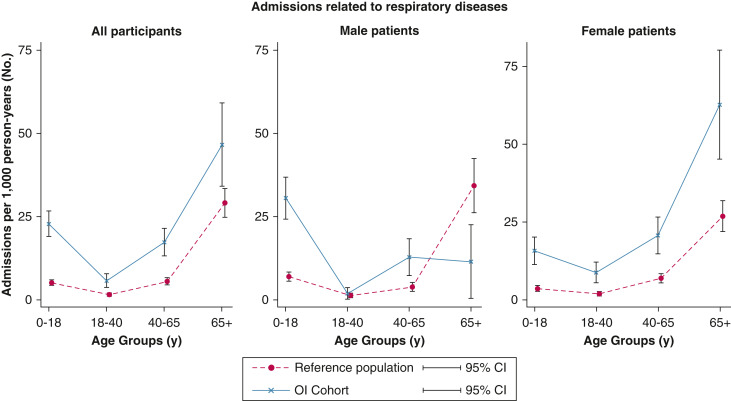
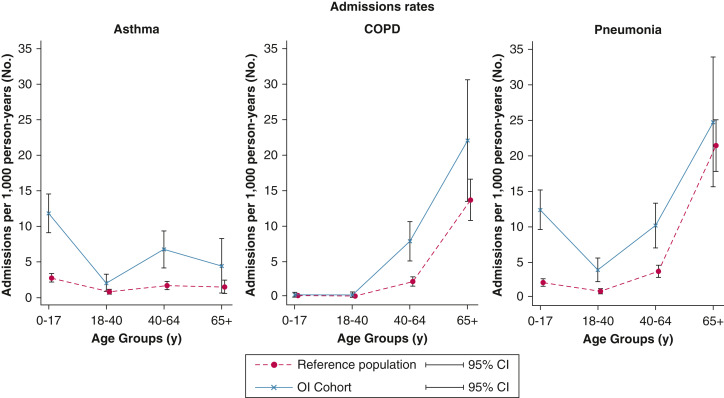
The median number of admissions per participant for asthma, COPD, or pneumonia was 1 (IQR, 1-2) in the OI cohort and 1 (IQR, 1-1) in the reference population. The median number of admission for any cause was 12 (IQR, 5-21) in the OI cohort and 4 (IQR, 2-9) in the reference population. Admissions resulting from respiratory diseases accounted for 2.2% of all admissions in the OI cohort and 2.7% of all admissions in the reference population (Table 1). The admissions rates for the most part were higher in the OI cohort compared with the reference population. The IR and IRR for admissions for any of the respiratory diseases or for asthma, COPD, and pneumonia alone are shown in Table 2 and Figures 1 and 2. The highest IR admissions for any of the respiratory diseases were observed in the oldest female patients aged 65 years or older, with an IR of 56.3 per 1,000 person-years in the OI cohort and 29.4 per 1,000 person-years in the reference population, with an IRR of 1.91 (IQR, 1.38-2.70), and in the youngest male patients aged 0 to 18 years, with an IR of 30.4 per 1,000 person-years in the OI cohort and 7.7 per 1,000 person-years in the reference population, with an IRR of 4.92 (IQR, 3.79-2.53). When evaluating the different disease groups alone, not surprisingly, we observed very few admissions for COPD in individuals younger than 40 years. We also observed that the IRs for pneumonia admissions showed a biphasic pattern, with the highest admission rates in the youngest and the eldest populations. In general, the admission rates were higher in female patients than in male patients for all of the diseases in question (Table 2, Fig 1).
Table 2. Admission Incident Rates and Admission Incident Rate Ratios for Respiratory Tract Disease Admissions
The IRR for COPD using a zero inflated Poisson regression model was 1.86 (0.99-3.47). Significant differences are indicated by boldface. IR = incidence rate; IRR = incident rate ratio; NA = not applicable; OI = osteogenesis imperfecta; TFE = too few events (to be shown in the table).
 Download: Download high-res image (362KB)
 Download: Download full-size image
Figure 1. A-C, Graphs showing the admission incidence rates for all of the respiratory diseases included in the study: all participants (A), male patients (B), and female patients (C). The admission rates are shown as admissions per 1,000 person-years. OI = osteogenesis imperfecta.
 Download: Download high-res image (391KB)
 Download: Download full-size image
Figure 2. A-C, Graphs showing admission incidence rates for asthma (A), COPD (B), and pneumonia (C) by age group per 1,000 person-years. Regarding COPD, too few events had occurred to be shown in the youngest age group. OI = osteogenesis imperfecta.
When evaluating the admissions rate ratios using a ZIP model, the IRR went toward 0. However, we still found significantly higher admission rates for any respiratory disease in male patients aged 0 to 18 years and 41 to 65 years. Furthermore, we found significantly higher admission rates for the age groups 0 to 18 years of age, 19 to 40 years of age, and 41 to 65 years of age in female patients with OI (Table 2).
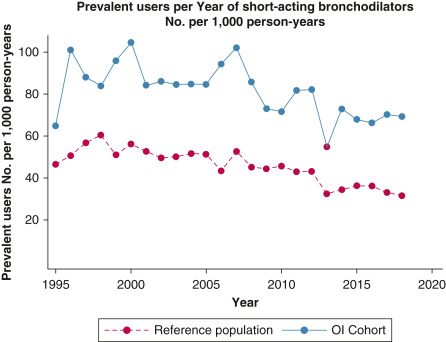
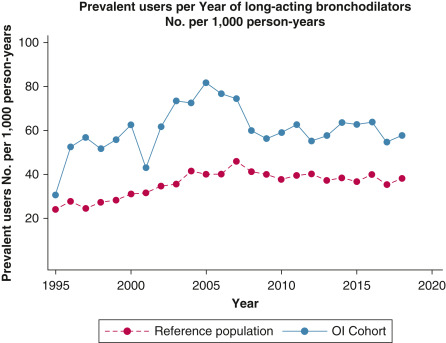
Figures 3 and 4 show the proportion of prevalent users of SABDs and LABDs from 1995 until the end of follow-up. For both types of drugs, we found more users per 1,000 participants in the OI cohort compared with the reference population. However, the trends seemed to follow the same pattern of relatively stable use of SABDs with a slight decline in users over time and an increase of users of LABDs from 1995 until 2010, when the number of annual prevalent users seems to be stable until the end of follow-up.
 Download: Download high-res image (235KB)
 Download: Download full-size image
Figure 3. Graph showing prevalent users of short-acting bronchodilators per 1,000 individuals per calendar year from 1995 through 2018. OI = osteogenesis imperfecta.
 Download: Download high-res image (229KB)
 Download: Download full-size image
Figure 4. Graph showing prevalent users of long-acting bronchodilators per 1,000 individuals per calendar year from 1995 through 2018. OI = osteogenesis imperfecta.
The median number of DDDs per participant for antibiotics was similar between the two cohorts, as seen in Table 3. For amoxicillin with β-lactamase inhibitors, the median DDD was 0, but the 95th percentile was 20 DDDs in the OI cohort and 10 DDDs in the reference population. The median DDD for dicloxacillin was 0 in both cohorts, but the 95th percentile was 60 DDDs in the OI cohort and 34 DDDs in the reference population.
Table 3. Antibiotic Drug Use as Measured by Daily Defined Doses
Variable
OI Cohort
Reference Population
P Value
β-Lactamase-sensitive penicillin
25 (0-136)
24 (0-117)
.25
Macrolides
5 (0-97)
5 (0-60)
.26
Amoxicillin with β-lactamase inhibitors
0 (0-20)
0 (0-10])
.19
Dicloxacillin
0 (0-60)
0 (0-34)
< .001
Data are presented as median (interquartile range) daily defined dose unless otherwise indicated. OI = osteogenesis imperfecta.
Discussion
In this nationwide register-based cohort study, we present data from the Danish health registers on the admission rates for asthma, COPD, and pneumonia as well as the use of bronchodilators and the use of antibiotics to treat respiratory tract diseases in individuals with OI and a reference group representative of the Danish general population. We found that individuals with OI showed increased use of bronchodilators compared with the reference population, with similar use of antibiotics to treat respiratory infections out of hospital, but higher admissions rates because of asthma, COPD, and pneumonia. This is the first nationwide register-based study, to our knowledge, on respiratory diseases in OI. The association between OI and admissions for respiratory diseases seemed stronger in female patients than in male patients with OI, without clearly identifying causes that could explain this difference. We can hypothesize only that some of this difference could be the result of anatomic and physiologic differences, such as smaller lung volumes and weaker respiratory muscles in female patients with OI, making them more susceptible to respiratory complications.
Historically, the pulmonary symptoms seen in OI have been described as secondary to scoliosis and spine crush fractures. However, a growing body of evidence suggests that the respiratory complaints in OI have an obstructive component: forced oscillation technique studies have identified obstructive pulmonary function13 and pulmonary imaging studies have found bronchial wall thickening14 to have a role. Bronchial wall thickening is found commonly in individuals with airway inflammation, chronic bronchitis, or COPD and asthma. This is in line with our findings showing a higher admission rate for COPD and asthma in the OI cohort. Normal collagen structure is important to the structural integrity, compartmentation, and functional capacity of the lungs.10 Several murine mouse models of OI have a pulmonary phenotype.25,26 In the Col1a1Jrt/+ model, a model of severe dominant OI, areas in the pulmonary tissue of distal airspace show enlargement indicative of pulmonary emphysema.27 The Aga2 mice, a model of mild or severe dominant OI with a COL1A1 gene mutation, have—at least for the severe forms—fracture-independent hemorrhage and inflammation throughout the lung tissue.9 More recently, Dimori et al28 published a large histologic, histomorphometric, micro-CT imaging and invasive study of the oim/+, Col1a2+/G610C, CrtapKO, and oim/oim OI murine models, mimicking mild to moderate to severe OI, and their data showed an impact of type I collagen alterations on lung morphologic features and function. This indicates that the collagen type I abnormalities and deficiency seen in OI lead to both primary microscopic and macroscopic changes in the respiratory system that may contribute to pulmonary morbidity in individuals with OI.
We found more users of both SABDs and LABDs to be more prevalent in the OI cohort compared with the reference population. Children with upper and lower respiratory tract infections tend to be wheezy, which can be a sign of asthmatic bronchitis. SABDs often are used as a treatment for these conditions, although the evidence of their effects is conflicting.29 We must assume, based on our data, that pneumonia is more prevalent in the OI cohort. This increased incidence in a young patient population could explain some of the differences in individuals using SABDs we have identified. However, it seems plausible that the changes in collagen type I seen in OI could result in wheezing, unrelated to infections, because of changes in the respiratory tract airflow. Similarly, patients with severe scoliosis may prompt an SABA prescription absent of wheeze or infection because of dyspnea symptoms alone.
We found a general increase in LABD use in the reference population over time. This increase in the Danish population has been shown by others.30 The increase in use over time is caused by a tendency to add more drugs after the diagnosis of a respiratory disease, combined with a reluctance toward discontinuing therapy.30 The reluctance toward discontinuation of therapy could be accentuated in individuals with OI because they are known to have increased pulmonary morbidity.16,17 Changes in prescription habits among clinicians over time also could influence our findings.
Our findings are in line with studies of pulmonary function in OI, where the pulmonary function test results are less than the expected values for sex, age, and height.12,25,31, 32, 33, 34 In a Norwegian cross-sectional study, Wekre et al31 included 97 adults with OI type I, III, or IV and found two patients with an obstructive pulmonary function pattern and four patients with a restrictive pattern when using actual height to predict the expected pulmonary function values. When using arm span as a proxy for height, the authors found two additional patients with pulmonary function abnormalities.31 Pulmonary function in OI often is reported as following a restrictive pulmonary function pattern, but our study indicated that the respiratory problems in OI could be obstructive. This needs to be evaluated further in future studies.
No differences were found in the use of antibiotics normally administered to treat respiratory tract infections between the OI cohort and the reference population. However, a significant difference related to dicloxacillin was found. The use of dicloxacillin may be higher in the OI cohort because of the presence of more skin infections related to fractures, and preoperative or postoperative use in this patient group as internal and external fixation devices may become infected. We can only speculate to why no increased use of antibiotics in the OI cohort was found, and one argument could be that general physicians will be more inclined to admit patients with a rare disease to hospital care for a pulmonary infection than to treat the infection at home with oral antibiotics. Comorbidity and risk of severe infections previously were suggested as causes of admission for community-acquired pneumonia.35
We saw higher admission rates for all respiratory diseases in the OI cohort compared with the reference population. We also found that when evaluating admissions related to asthma, COPD, or pneumonia on their own, the same pattern emerged. Only the eldest male patients with OI seemed to have lower admissions rates than the reference population. We previously saw similar findings regarding fracture rates.3 Patients with the most severe phenotypes of OI will have increased risk of early death,16,17 leading to a positive selection of patients with milder phenotypes and less comorbidity in the older age strata of male patients. However, fractures and fracture-related treatment may result in immobilization in patients with OI. Fractures also may increase the prevalence of pain. Pain can be exacerbated during coughing. These factors may influence the risk of respiratory tract infections in OI. We previously showed that fracture rates are higher in children and the oldest adults in this cohort.3 We cannot rule out that a correlation exists between fracture rates and risk of respiratory tract infections in the cohorts in our study.
We and others have shown that respiratory tract diseases are a leading cause of death in individuals with OI.16,17 In a previous study, we found that compared with the general population, individuals with OI showed an increased risk of death resulting from respiratory diseases. This is in line with the findings that the admission rates for pulmonary diseases are higher in patients with OI, as shown in the current study. Between 1994 and 2003, the incidence of hospitalized pneumonia in Denmark has increased from 288 admissions per 100,000 person-years to 442 admissions per 100,000 person years.35 We do not have statistical power to evaluate the trends in admissions over time. The admissions rates in the reference population are lower that what has been reported previously, but this could be influenced by the age distribution of our cohorts.
This study has several limitations. First, we have no clinical data on the severity of pulmonary disease leading to admission. We cannot rule out that a patient admitted for surgery, for example, who is known to have stable asthma is registered with an asthma diagnosis. We have counted admissions related to respiratory diseases only using the primary diagnosis in the national patient register, and the number of admission was lower (259 vs 337 in the OI cohort and 385 vs 541 in the reference population). Nevertheless, the current coding practice dictates that the codes that are registered for an admission are related to the diagnostics and treatment a patient has undergone during that admission. Nor do we have information about risk factors for pulmonary diseases such as smoking. Using register-based data, we have to rely on the decisions made by the clinicians who treated the patients and must assume that admissions to the hospital were needed. Second, we have no clinical (such as prevalence of scoliosis and mobility) or genetic information on the severity of OI or any indication of pulmonary function in the participants. Clinical and genetic data would have enabled us to perform subgroup analyses evaluating the effects of OI type, mutation, or both on the risk of pulmonary morbidity in individuals with OI. Finally, we lack data on the phenotype of respiratory diseases present in the admitted patients, some of whom may not fit within the current International Classification of Diseases, 10th Revision, diagnosis. Future studies not only should focus on the prevalence, but also the phenotype, of respiratory diseases in OI. Such studies will identify if individuals with OI have increased risk of COPD or asthma or a different cause of obstructive pulmonary diseases. Our study also has several strengths. First, the national registers used in this study have a coverage of > 99% in a country with a uniform tax-financed health care system and have complete long-term follow-up, further strengthening our results. Second, the positive predictive value—or the risk that a patient having the disease is registered in the registers
Interpretation
Overall, individuals with OI had higher incidences of hospitalizations resulting from respiratory disease and a higher use of bronchodilator use when compared with a reference population representative of the general population in Denmark. Based on our findings, increased clinical and research awareness and focus on pulmonary morbidity is needed in OI. Further studies to evaluate if pulmonary function tests can identify high-risk patients are needed. Timely diagnosis and treatment of respiratory insufficiency to aid respiratory challenges in individuals with OI is warranted.
Acknowledgments
Author contributions: J. D. A. contributed to conceptualization, writing the original draft, review and editing the manuscript, and methodology. M. L. L. contributed to conceptualization and reviewing and editing the manuscript. M. K. H. contributed to conceptualization and reviewing and editing the manuscript. D. P. H. contributed to conceptualization and reviewing and editing the manuscript. A. C. contributed to conceptualization and reviewing and editing the manuscript. C. B. L. contributed to conceptualization and reviewing and editing the manuscript. A. F. contributed to conceptualization and reviewing and editing the manuscript. L. F. contributed to conceptualization, reviewing and editing the manuscript, methodology, formal analysis, visualization, and funding acquisition.
Role of sponsors: The sponsor had no role in the design of the study, the collection and analysis of the data, or the preparation of the manuscript.