
NEUROPATHIC PAIN, AND ITS RELATION TO OI
Recently a National Survey was published involving pain and OI. Although Nationwide, the sample size was smaller than one would wish, because it was very specifically restricted to OI patients and their care givers. Sometimes you “friends” will notice things that you may not be ready to admit.
The results , that we're interested here, broke out like this:
Of the respondents the majority were OI Type 1 (70%), the next most prevelant group was Type 3 at 15%. Again, this isnt very surprising as I do more research about OI and its causes etc, that falls in line with the information released POST 1996. I think most of us are told that Type 1 is the most common and the “mildest” form, although there is a lot of information being tossed around suggesting that the term 'mild' should be changed. As someone in that group I can admit that at 100+ fractures and most major joints replaced or repaired, I have to ask what the definition of mild actually is? I know that many physicians are suggesting that term came about not as a direct comparison but as a way to calm parents into understanding that their child should be able to live a mostly “normal” (whatever that means) life.Wrapping it up were types 2 and 4 with 8 and 7% each. Unfortunately those come in so close to the standard error of deviation on this particular survey its hard to suggest the actual weight. Perhaps another survey primarily focused on those 2 groups would prove more fruitful.
The stated goal of the survey was merely cataloging pain in a specific direction, I personally found it interesting that the majority of respondents did experience pain on a consistent basis, even with no KNOWN fractures present.92%. I'm not a medical scientist, just a numbers guy, but I would certainly believe that this must lean towards a permanent component of OI being systemic and chronic pain. From the physicians point of view however, the majority of what they have been taught is, “The pain starts from an injury, may proceed through healing factors (swelling) and then persist through the rehab phases, but should stop at some point. Orthopedic Physicians are a great relation to the construction analogy where if your a Hammer, every problem looks like a nail. Therefore, maybe some additional speciaty physicians should be consulted. I know for fact that this can be a huge change in ideation for many with OI. For the first ½ of my life my Primary Physician listed on my medical records was an orthopedic Surgeon. Then, as all good Doctors do, he went and retired..
Looking back at the patient/doctor relationship the massive skew in the question of has your physician mentioned Neuropathic Pain potential (80+%) leads one to believe that either this is not being taught, either in medical school, or in continuing education. OR its not being taught clearly enough so that “The Hammers” might see it as a potential connection.
Additionally fewer than 10% of the respondents ever asked their physicians about it, but that does work right alongside the 50% of respondents who suggested they were not asking their Doctors about it because they didn't know about or know enough about Neuropathy to ask the question. Those numbers make perfect sense to me, as it is a very difficult type of pain to wrap ones head around. At least for me.
75% of the respondents did suggest that they would be willing to consult a “different” type of physician for pain relief of they thought it would help. No unfortunately there was absolutely ZERO explanation along with this question, so I propose the following. 1) Everyday we see friends and acquaintances on FB comment about how they sometimes feel “ignored” or their pin comments disregarded by their “Primary” physician. However in my own experience there seem to be three classifications of physicians , here in Fl. That have experience with Neuropathic pain. A) Pain Specialists – unfortunately depending on their history in medicine they often fall into one of a few categories. Either they are former trauma Doctors who are looking for specific but OVERWHELMING pain points to focus on. Former Anesthesiologists, who are looking at numbing the patients system as a whole, again their specialty is keeping people from being aware of pain during surgery. Finally are the “Sports Medicine Specialists” who again are looking for concussions, or joint failure or broken bones. I'm sure in other locations there are additional classification, but that seems to be the 3 primary types of doctors here that work in that field. Finally are the “Doctors” (occasionally PhD rather than MD) working in holistic medicine, or who may have an alternative agenda at foot. I knew one patient whose “primary physician” was an acupuncturist. Please understand I am not denying the effectiveness of Eastern Holistic medicine. However, if you have an insurance company that covers a holistic doctor as a primary physician please let us know. That's an insurance company that needs better press.
In my experience I had 5 physicians in 1 week recommend Neuropathy as a potential, and they all recommended one specialty. They said my best bet was a Psychiatrist. Now I've worked with Psychs before and have nothing against them. Their medicine was explained very carefully to me (watch for my upcoming book for more info), and I know for a fact in certain circumstances it is amazingly effective. Alternatively there is often a stigma that carries with being a patient, and if you watch “reels or short videos” on any social media platform, you probably see folks bragging about their mental health issues and determine that, you'd rather suffer than sit in the waiting room with some of them, for more than 30 seconds.
One number that doesn't carry a lot of weight in this discussion I was very glad to see and that was that 2/3's of the respondents were actively under the care of a pain management specialist. Now the survey was not specific enough to absolutely make that connection, but if your “primary physician” is the one handling you oain management you might look into transferring THAT part of your care to a specialist. I will only speak of personally experience here, but I started with my primary handling pain management, but then when it got to a level he wasn't comfortable with he referred me to a pain management clinic run by one of the local hospitals.
If you are of a certain generation you were exposed to “after school specials” which were 2 hour long PSAs to support the first lady “Don't DO Drugs campaign. And the mere mention of “Methadone Clinic” brigs to mind addicts wasted on the sidewalks, needles hanging out of their arms, biceps still bound up in a tourniquet. As a matter of fact about 5 years ago when I was looking for another Pain Clinic I actually had a very exclusive, non insurance billing clinic use that exact description to me while attempting to prove why THEIRS was the best way. Why they even had their own patented method of combating pain like mine that would make me feel whole again. BTW THAT IS A HUGE RED FLAG, for me. Any 'medical facility' that openly mocks others, and has a “patented, proprietary or other “secret” method, may as well be hosted by an AI on Tik Tok.
In my world my only experience with Neuropathy came from a neighbor who was Diabetic, His car got stuck in a 3 foot “puddle” during a storm and my sister and I came upon him wailing for help. I offered to try and push him out, but asked him to exit the vehicle, he was not a small boy. It was at that point that he cried that he couldn't get out because he was diabetic and couldn't get his feet wet. Dude you live on a peninsula, you need to move.
Over the next 45 minutes I was able to manually push the car out and he sat ling enough for the wires to dry so he could continue on his way. When I got home for a change of clothes, mom looked at me and immediately wanted to know what happened. SO I explained to her about Jimmy, and his diabetes. Knowing that her Mom suffered from diabetes as well, I asked what getting your feet wet had to do with anything?
That's when Mom explained that my diabetics suffered from the specific kind of pain that often started in their feet and seemed to be incredibly powerful. As years went by and I worked in Healthcare for 20 years you learn things even if you don't ask questions, but essentially it was explained to me like this:(this is a VERY simplistic explanation)
For Diabetics, who have a challenge processing sugar to start with, so anything related to processing carbs is going to be a challenge. Now imagine that your nervous system is one huge wiring harness. The one difference is that in this harness the wires often end, at seemingly random places, but are near the skin so as to register any contact.
Diabetics have 2 big challenges with this harness. First off, years and years of carb consumption and improper processing often leaves a coating of “poisons” or inflammation causing substances on the ends of the wires. Add to that the fact that these poisons or constant bouts of inflammation can actually cause the body to stop or miscalculate the nervous responses that are triggered by this “sensory touch” That all feeds back to the diabetic patient as pain. Think about it, in that kind of illustration your feet and hands are the 'end points' for communication and traffic, plus in regards to the feet what we , as civilized folks, do is wrap them up tight in shoes all day, and further restrict the free flow of blood, nerves and other healing chemicals. Pile on top of that the fact that your feet each have to hold up 100% of your weight at alternating times during the day (and if you know anyone with Diabetes they are often dramatically overweight). That's a lot of pressure supported by such a small area.
So what does that have to do with OI folks?
That's a darn good question, because while there has been research performed, most of it is “recent” and almost all of it is very underfunded.
For example the primary tier if research into this are Studies that directly measure or address Neuropathic or nerve-related pain in OI folks. Unfortunately they start with a handicap. Does your Doctor have a gizmo he can lay across your forehead, wrist or chest that will then give him a definite number that will demonstrate to him, without a doubt A. That you are in pain and B. Just how much pain you are experiencing. Because if your Dr has one of those I need to find out more about it. Treating pain is difficult primarily because it is so subjective. I've broken my arm and had to resent it from a 90 degree angle break, and then carried on a perfectly normal conversation with the EMTs. Everyone experiences it m,, or not, differently.
Add to that the idea that OI folks , in my observation, work very hard every day not to burden the folks around them with their suffering that they are often so good at hiding or covering up the pain, that its hard to let your guard down so folks can actually see a sense of what you're experiencing.
So while the level of Neuropathic pain we might feel , in comparison to a thigh fracture, is about 90% less, if it is always present, and brings with it associated issues, than it can become a major part of your life.
The next level of research has focused on Neurological complications that cause nerve pain in OI folks. That brings with it, its own set of issues. For example, an Orthopedic Surgeon I worked with for years, loved and respected (Hey Dio W.) went through this “thing” every day for 6 weeks that I was inpatient for a fall. I was in 6 point traction, one leg up in the air, opposite arm the same, and the other 2 alternates in various stages. All while an 18” screw stuck out the side of my leg with an 80lb sandbag hanging off it to hold my leg OUT of the socket. Anyway, during his daily visits he would grab the injured leg and twist and move and yank. It was everything I could do not to burst into tears, and his primary Nurse, and angel on earth if there ever was one, could see the anger and frustration building behind my bit lips and closed eyes. One day after Doc went next door, she patted me on the knee and said, “That really hurts doesn't it?” She was a Lady, so I would never say what was coming to my lips, but through clenched teeth I replied” That obvious huh?” She said very sweetly with a slight southermn accent. Well I'll ask you to forgive Dr. W. see he knows mechanically that it proably hurts, but hes never been where you are, so he probably cant even imagine how MUCH it hurts.” That made a huge differnce in my day and my attitude. But again, were dealing with Dr's who have a solution somewhere in their little black bag (that probably has a BLACK and DECKER sticker on it somewhere), but have never felt what that solution feels like. Now I have been told that in some medical schools Ortho Drs are being required to have a cast applied and then one of their students saw it off. But I need video evidence please....
Finally comes the field of research focused on OI pain studies that refer to pain type or mechanisms but don't measure neuropathic pain. Because again, there is NO measurement device, their isnt even a standard pain scale they can refer to. What is a 9 for you today could be a mostly 7 tomorrow, where as for Betty its a 3 and, so on. But since you can point to a place on a Xray of MRI and say, well if THATS broken, thats goting to cause a great deal of pain. But have zero comperable ways to work with Neuropathic pain, it suddenly becomes almost a side item.
Any of you ever know someone in the past who said they had “Fibromyalgia?” I know during the 1990s and early 2000s that was a HUGE buzzword in medicone and no one wanted to talk about it, and no one wanted to deal with it, because their patients appeared to be experiencing crippling pain, but nothing seemed to help, and there was nothing mechanically or biologically wrong that any scan or test could find? I know because someone I cared for deeply at that time was trying to work through that and 2 premie babies after dad took off.She was not faking her pain or its debilitating effect on her life, but she culdnt get a Dr to treat her for anything that seemed to work.
Today, one of the wisest Doctors I know, doesnt claim to have all the answers, but he IS a sideline historian, as well as a renowened internal medicine Dr. One thing he picked up on almost immediately is that the numbers in America, started to change dramatically after WWII. Dr,. S realized that in their efforts to stablize food longer, so it could survive the trip to the European battlefields and help rebuild countries like france and Denmark, certain ingredients were added, and certain ones taken away that seemed to directly effect the health of the country as a whole.
For example their was a lubricant invented during the war that was designed to be placed into tank parts to help preserve them whether they were being flown somewhere, where the thinner air carries almost no humidity or transported by ship where humidity was almost 100%. Food packagers found that this lubricant was “non toxic” by the standards then, and could be added to certain foods and those foods would then stay fresher longer. Lets all say it together High Fructose Corn Syrup. The givernment was paying farmers to grow corn, then ended up with a huge surplus. Since the human body cant digest corn, watch what your dog leaves in the grass after thanksgiving dinner, they couldnt feed the soldiers in the firld corn. Couldnt leave evidence. But by using it as a lubricant for heavy mechanics and as a food preservitive and additive, it must be a win win situation right?
Until studies decades later suggested that your body didnt digest THAT either, and instead stored it in certain areas of the body not MEANT to be storage tanks, and that set off areas of inflammation, that no one could find a source for, Am I suggesting that of you eliminate HSCS from your diet your pain will go away? Absolutely not! But it is one of the things we are very vigilante in our house to watch for,
The studies on that inflammation found a certin cycle occurring in people. They would, for example, have a meal on monday that needed a lot of HFCS, then not again for the following week. Patients would start complaining of knee and joint pain 'flaring up” with no seeming cause. These studies also fuond that if there were a certain number of days between meals like that, the cause would eventually burn itself out and the inflammation would lessen. But the very next time anything with HFCS was on the menu. It started all over again.
Pain studies that work on these types of issues are more and more common as we find more and more people with pain related issues at times in their lives when they should not be having them. For example, my mom suffered from Rheumatoid Atrhritus all her life. Im not an expert but I have been on the lookout all my life. However as many injuries and joint repairs as I have had I knew I would experience OSTEOarthritus at some point without a doubt. Imagine my SHOCK when it hit seemingly overight, and focused itself in my HANDS. Again, the ends of the circuit. And it is ALWAYS made worse by over consumption of sugar. Whats considered overconsumption? Ask your primary physician, that number should be calculated based one several very personal items, such as height, weight and age. But to give you an idea, in college I went a whole semester having a Chocolate Eclair and a Grapefrit juice for breakfast every morning. Looked and felt the best I had in my LIFE. Went off for a long weekend wto celebrate an anniversary with my wife, had donuts 2 days for breakfast and came home feeling like my knees had been replaced with volleyballs.
So, other than watching what you eat, what can you do about neuropathic pain? Well in my case, and this is very hard to find specifics on, as I suggested I was referred to a Psychiatrist for treatment. Great guy, has never tried to shrink my head or any other part of my body, and has no interest in marital issues or anything else. But he told me right off the bat that there was a very specific mood stablizing drug on the market that had been approved by the FDA for the treatment of Neuropathic pain. It was listed as a KNOWN SIDE EFFECT.
When I thought about it, it made perfect sense. Walk with me and the ask yourself if this feels familiar. Zi have a regular pain medicine regimine and if my alarm goes off every X hours and I take a pill I'm pretty good for a whole day. But if the alwarm doesnt go off or I dont hear it, or Im in the middle of writing and say “I'll get it at the end of this paragraph” several things start to creep into my world.
First off I start to get very very tired. Now I have sleep Apnea, so it could be my mask moved sidways or what have you, but it just slowly slides over me.
Secondly I start to feel depressed. Not clinically depressed, just sad and not wanting to do anyting, especially if I have to MOVE to do it. I tell the Dr its like someone slid a lead blanket over my shoulders while I wasnt looking.
Finally my brain wakes up for a minute and reminds me I may have missed a pill, so I get up to check, and THATS when the pain washes over me full force. Its back wth a vengence, Im stooped over, shuffling and depressed. I take my medicine and within 30 minutes all is well with the world.
If that sounds anything similar to what you experience, ask yourself this. If I had a medicine tht didnt allow stage TWO to take hold. Its a mood stabilizer, so im pretty consistent all day, even when I get behind, but if I think I feel OK than the Neuropathic pain wont register as high on my pain scale. Please dont think this solves everything. Hand me a new jar of maynaise and I will swear my fingers are breaking off one by one before I get it open, but there is a buffer of reliefe.
If that sounds familiar and you have ANY reservations about seeing a Psychiatrist, please dont letit stop you. If you dont know one, call theinsuarnce company, they have people whose only job is to find you a new Doctor. You can even ask if they have experience wth neuropathic pain. Just because insurance doesnt know, doesnt mean he doesnt, it just m,eans he hasnt told them about it yet.
Following will be where I got my information from, read through or preuse at your pleasure.
OI and Neuropathic Pain: Literature and Trials, Jan 2006 – Oct 2026
Nov 1, 2026 · @Jerome hess
Tier 1: Studies that directly measure or address neuropathic or nerve-related pain in OI
1. Legrand MA, Clemeno FA, Chapurlat R, Irani A, et al. (2026). Addressing the unmet challenge of pain in rare bone diseases: new insights from the RUDY UK registry. Orphanet Journal of Rare Diseases 21(1):33, published Jan 29, 2026. DOI 10.1186/s13023-025-04167-4. PMID 41612382.
Type: cross-sectional registry study (adults with OI, FD/MAS, XLH).
Neuropathic relevance: used the painDETECT questionnaire to classify pain as nociceptive, unclear or neuropathic-like. Neuropathic-like pain and female sex were significantly associated with worse pain outcomes. Generalized pain was linked to anxiety, depression and sleep impairment, pointing to nociplastic features.
Most recent and most directly relevant paper on the list.
2. Muñoz Cortés R, Soriano Pastor JF, Monsalve Dolz V. (2022). Chronic pain in adults with osteogenesis imperfecta and its relationship to appraisal, coping, and quality of life: a cross-sectional study. Medicine (Baltimore) 101(40):e30256. DOI 10.1097/MD.0000000000030256. PMID 36221335.
Type: cross-sectional survey, 418 adults with OI (Spain).
Neuropathic relevance: painDETECT results classified 61.7% as nociceptive, 16.3% as neuropathic and 22% as doubtful. The first large OI-specific estimate of a neuropathic pain component.
3. Abdelaziz DM, et al. (2015). Behavioral signs of pain and functional impairment in a mouse model of osteogenesis imperfecta. Bone 81:400–406. DOI 10.1016/j.bone.2015.08.001. PMID 26277094.
Type: animal experiment (Col1a1Jrt/+ mouse, severe dominant OI).
Neuropathic relevance: OI mice showed hypersensitivity to mechanical, heat and cold stimuli (von Frey, radiant heat, acetone tests), a pattern consistent with chronic pain sensitization. No change was found in skin innervation or CGRP expression in sensory neurons. This is the only OI animal study found that tests pain behavior.
4. Ruschel LG, Agnoletto GJ, Hunhevicz SC, de Almeida DB, Arruda WO. (2017). Alternative option for osteogenesis imperfecta and trigeminal neuralgia. Revista da Associação Médica Brasileira 63(4):307–310. DOI 10.1590/1806-9282.63.04.307.
Type: case report.
Neuropathic relevance: 28-year-old woman with OI type III and trigeminal neuralgia secondary to basilar invagination. Treated with CT-guided percutaneous balloon compression of the Gasserian ganglion, with good pain control.
5. Sarkar M, Pillai A. (2018). Trans-sylvian approach to microvascular decompression for trigeminal neuralgia in syndromic cranial base settling. Operative Neurosurgery (Hagerstown) 15(2):E9–E12.
Type: case report / surgical technique.
Neuropathic relevance: 34-year-old man with OI and severe basilar invagination with trigeminal neuralgia. Complete resolution, pain- and medication-free at 18 months.
6. Tucker-Bartley A, Lemme J, Gomez-Morad A, et al. (2021). Pain phenotypes in rare musculoskeletal and neuromuscular diseases. Neuroscience & Biobehavioral Reviews 124:267–290.
Type: review covering 10 rare diseases, including OI.
Neuropathic relevance: describes pain sources and phenotypes (including neuropathic mechanisms) shared across rare diseases and proposes ways to study them in parallel.
7. EuRR-Bone OI Study Group: Pain Study in Osteogenesis Imperfecta (ongoing registry study, announced ~2024–2025).
Type: European registry-based observational study.
Neuropathic relevance: uses the Neuropathic Pain Symptom Inventory (NPSI) alongside the Brief Pain Inventory, EQ-5D and WHO ICF mobility. Results not yet published as of this list. Source:
 eurreb.eu.
8. OIF / OIFE Topical Meeting on Pain and OI: meeting summary (grey literature).
Type: expert meeting summary (Osteogenesis Imperfecta Foundation).
Neuropathic relevance: presentations reported that neuropathic and nociceptive pain are both common in OI, that only nociceptive pain was tied to reduced physical function, and that assessment tools able to separate the two are needed. Includes a talk on pain and basilar invagination (Eva Åström). Source:
oife.org.
Tier 2: Neurological complications that cause nerve pain in OI
9. Cobanoglu M, Bauer JM, Campbell JW, Shah SA. (2018). Basilar impression in osteogenesis imperfecta treated with staged halo traction and posterior decompression with short-segment fusion. PMID 30443144; PMC6187899.
Type: case report.
Relevance: OI type III with basilar impression, Chiari I malformation, hydrocephalus and cervical syrinx. Syrinx and compression are recognized causes of central neuropathic pain. Pain is described during traction, but neuropathic pain is not the focus.
Note: basilar invagination and craniocervical papers in OI are numerous. Only those that discuss nerve pain are listed. A full basilar invagination sweep would add many surgical papers that mention pain only in passing.
Tier 3: OI pain studies that refer to pain type or mechanisms but don't measure neuropathic pain
10. Rodriguez Celin M, Kruger KM, Caudill A, Murali CN, Nagamani SCS, Smith PA, Harris GF, et al. (2023). A multicenter study to evaluate pain characteristics in osteogenesis imperfecta. American Journal of Medical Genetics Part A. DOI 10.1002/ajmg.a.63009. PMID 36271817.
861 participants from the Brittle Bone Disorders Consortium. Chronic pain in 41.8%, back pain most common. Predictors were age, wheelchair use and fracture rate.
Earlier conference abstract: Rodriguez Celin M, et al. (2021). Multicenter Study of Pain in Osteogenesis Imperfecta. Archives of Physical Medicine and Rehabilitation.
11. Shepherd WS, Wiese AD, Cho HE, Rork WC, et al. (2024). Psychosocial outcomes of pain and pain management in adults with osteogenesis imperfecta: a qualitative study. Journal of Clinical Psychology in Medical Settings. DOI 10.1007/s10880-023-09991-z. PMID 38281305.
15 adults interviewed. Themes included pain-type variability, stigma around pain medication, and low physician knowledge of chronic OI pain.
12. Nghiem T, Chougui K, Michalovic A, Lalloo C, Stinson J, Lafrance M-E, Palomo T, Dahan-Oliel N, Tsimicalis A. (2018). Pain experiences of adults with osteogenesis imperfecta: an integrative review. Canadian Journal of Pain 2(1):9–20. PMID 35005360.
14 studies reviewed. Search terms included "nocicept*". Concluded that adult OI pain is understudied.
13. Provenzano AH, Åström E, Löwing K. (2022). Exploring pain interference and self-perceived health status in children with osteogenesis imperfecta: a cross-sectional study. BMC Musculoskeletal Disorders. DOI 10.1186/s12891-022-05825-5. PMID 36131255.
Pain present in 27 of 28 children (Sweden).
14. Westerheim I, Hart T, van Welzenis T, Lande Wekre L, Semler O, Raggio C, Bober MB, Rapoport M, Prince S, Rauch F. (2024). The IMPACT survey: understanding the experience of children, adolescents and adults with osteogenesis imperfecta and their caregivers. Orphanet Journal of Rare Diseases 19:128. DOI 10.1186/s13023-024-03126-9.
International survey. Pain was among the most frequently reported and most impactful symptoms.
15. Danish OI pain pilot (2024). Evaluation of the Nordic Musculoskeletal Questionnaire for measuring prevalence and the consequence of pain in a Danish adult OI population: a pilot study. Calcified Tissue International. DOI 10.1007/s00223-024-01262-9.
16. Carroll RS, Donenfeld P, McGreal C, Franzone JM, Kruse RW, et al. (2021). Comprehensive pain management strategy for infants with moderate to severe osteogenesis imperfecta in the perinatal period. Paediatric & Neonatal Pain 3(4):156–162. DOI 10.1002/pne2.12066.
17. Genetic metabolic bone disease pain study (2025). Pain intensity in patients with genetic metabolic bone diseases: an observational study. Bone (ScienceDirect PII S8756328225003485). 68 patients, 72% with OI.
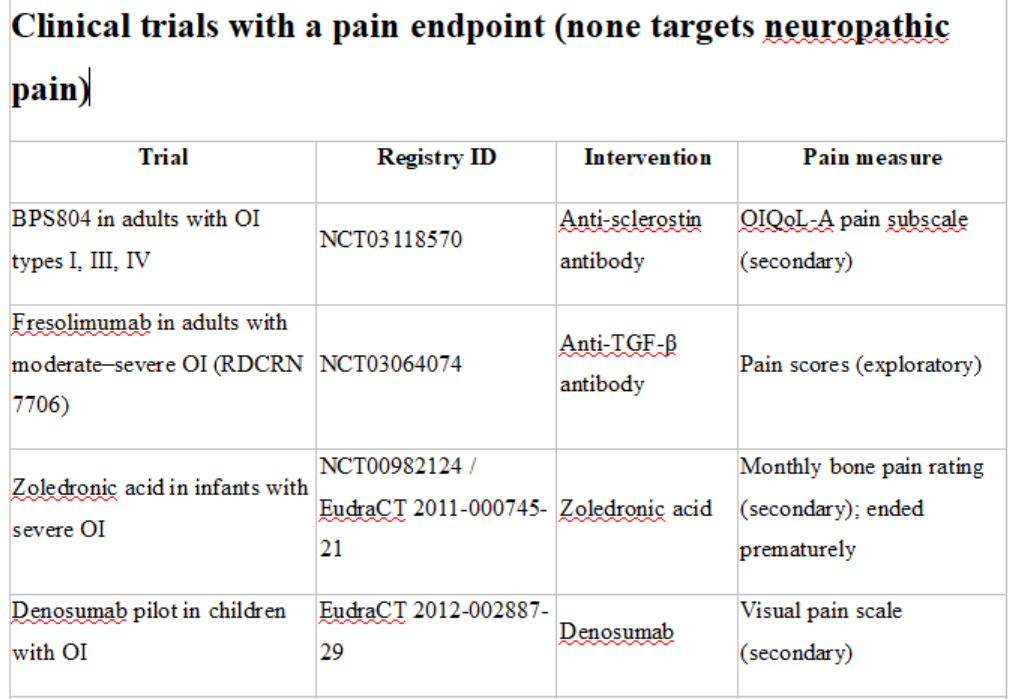
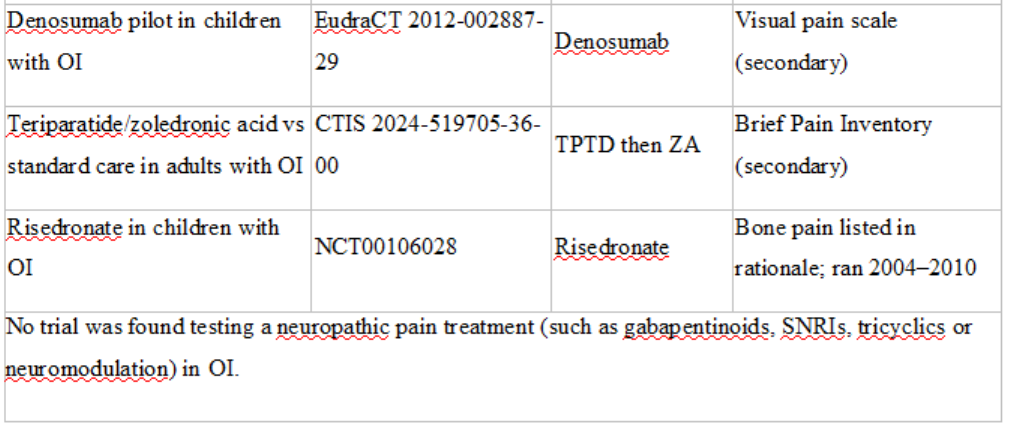
Clinical trials with a pain endpoint (none targets neuropathic pain)
Found but outside the date range (before 2006)
These are often cited in the papers above but predate January 1, 2006:
Zack P, Franck L, Devile C, Clark C. Fracture and non-fracture pain in children with OI. Acta Paediatrica 2005.
Hajioff D, et al. Precise cannulation of the foramen ovale in trigeminal neuralgia complicating OI with basilar invagination. Neurosurgery 2000.
Hayes M, Parker G, Ell J, Sillence D. Basilar impression complicating OI type IV. J Neurol Neurosurg Psychiatry 1999. Concluded that trigeminal neuralgia in OI should prompt imaging for basilar impression.
Reilly MM, et al. Trigeminal neuralgia associated with OI. J Neurol Neurosurg Psychiatry 1995.
Álvarez López JC, et al. Pain treatment in a case of OI type III (cites neuropathic pain pharmacology). Anales de Pediatría 2002.
Gaps worth noting for advocacy
Only two human studies (2022 and 2026) report how much OI pain screens as neuropathic. Both used painDETECT and found a meaningful minority: about 16% neuropathic plus 22% unclear in the Spanish cohort.
The only mechanistic animal work (2015) found sensitization without nerve-structure changes in the skin. Nobody has published bone-innervation or dorsal root ganglion studies in OI mice since.
Trigeminal neuralgia from basilar invagination is the best-documented specific neuropathic syndrome in OI, but evidence is limited to case reports.
The EuRR-Bone study using the NPSI will be the first registry data built specifically to capture neuropathic pain in OI.
Think of your nerves as long electrical wires running from your spine out to every part of your body. Diabetes damages those wires in two ways at once.
Why the nerves get damaged
Sugar is hard on the wire itself. When blood sugar runs high for years, the excess sugar gums up the nerve’s internal machinery and produces chemical byproducts that slowly poison it.
The supply lines get choked off. Every nerve is fed by tiny blood vessels. High sugar damages those too, so the nerve is slowly starved of oxygen and nutrients.
Why that causes pain instead of just numbness
A damaged wire doesn’t simply go dead. Like frayed wiring that sparks and crackles, a sick nerve misfires, sending signals when nothing is actually happening. The brain reads those false signals as burning, stabbing, tingling, or electric shocks. The thinnest nerve fibers, which carry pain and temperature, have the least protection and tend to be hit first. That’s why a person can have numb feet that also hurt: real signals aren’t getting through, but false ones are.
Why the feet
It comes down to length. The nerves to your toes are the longest in the body, about three feet from the spine in an adult. Each nerve is a single cell, and its “headquarters” is up near the spine. Everything the far end needs has to be shipped down the entire length. When the nerve is sick and undersupplied, the farthest point gets shortchanged first, like the last house on a long, failing water line.
So the damage starts at the toes and creeps upward. Once it reaches about mid-calf, the fingertips often start too, because the nerves to the hands are about that same length. Doctors call this the “stocking and glove” pattern.
Why it’s so common
The damage is cumulative. It depends on how high the sugar runs and for how many years. Since diabetes is lifelong, roughly half of people with it eventually develop some nerve damage, and a good share of those have the painful kind.
why Diabetics Develop Neuropathy — and Why It So Often Starts in Their Feet
One of the most interesting things about diabetic neuropathy (nerve damage caused by diabetes) is that the pain often begins in the feet, even though the underlying problem involves the entire body's ability to regulate blood sugar.
There is a fairly straightforward explanation, and it involves three things: sugar, blood vessels, and the length of our nerves.
1. How diabetes damages nerves
Think of your nervous system as an enormous network of electrical wires running throughout your body.
These wires carry messages back and forth between your brain and the rest of your body. Some tell your muscles to move. Others report temperature, pressure, touch, and pain.
Now imagine that these electrical wires are surrounded by tiny blood vessels that supply the oxygen and nutrients they need to function.
When someone has diabetes, their blood sugar can remain elevated for long periods. Over time, this can cause two major problems.
Direct nerve damage: Excess sugar sets off chemical reactions inside nerve cells that interfere with their normal operation and damage their internal structures.
Damage to tiny blood vessels: High blood sugar can injure the small vessels that nourish nerves, reducing the oxygen and nutrients reaching them.
The result is a nerve that gradually loses its ability to transmit accurate messages.
And here's the fascinating part:
A damaged nerve doesn't necessarily stop sending messages. Sometimes it starts sending messages that aren't true.
For example, a nerve might tell the brain:
"My foot is burning!" even though the skin is perfectly cool.
"Something is stabbing my toes!" even though nothing is touching them.
"There's an electrical shock!" even though there's no external electrical source.
Or, just as dangerously, it may stop reporting pain altogether.
This is why neuropathy can cause both extreme pain and complete numbness, sometimes in the same person.
2. Why does it usually start in the feet?
Body systems — Science Learning Hub
Peripheral nerves must carry signals over considerable distances, particularly between the spinal cord and the toes.
This is probably the most important part of the explanation.
The nerves reaching your toes are among the longest nerve fibers in your body.
Imagine running an electrical cable from your house to a shed 10 feet away, and another cable to a shed 500 feet away.
If both cables begin to deteriorate, the longer cable is generally more vulnerable to problems because it has much more distance to maintain.
Something similar happens with diabetic neuropathy.
The nerve fibers reaching your toes have to maintain and supply their farthest ends over a very long distance. When diabetes interferes with the nerve's energy supply, internal transport system, and blood supply, those distant ends are particularly vulnerable.
Doctors call this length-dependent peripheral neuropathy.
The typical progression looks like this:
Toes: Tingling, burning, numbness, or unusual sensitivity begins.
Feet: Symptoms spread across the soles and tops of the feet.
Ankles and lower legs: Damage progresses upward in what doctors call a "stocking pattern."
Hands: With more extensive nerve damage, symptoms may eventually appear in the fingertips, producing a "stocking-and-glove" pattern.
The important distinction is that the disease doesn't necessarily originate in the feet. The feet are often where the damage first becomes noticeable.
3. Why can the pain be so severe?
Normally, pain is a warning system. You step on something sharp, your nerves report the danger, and your brain tells you to move.
But damaged nerves can become electrically unstable.
Think of an old radio with faulty wiring. Instead of delivering a clean signal, it produces static, pops, and unpredictable bursts of noise.
Damaged nerves can behave similarly, generating abnormal signals that the brain interprets as pain.
This helps explain why someone with diabetic neuropathy might experience terrible burning pain from something as harmless as a bedsheet touching their feet.
The bedsheet isn't injuring them. Their nervous system is interpreting an ordinary touch as a painful event.
And some people experience the opposite problem: they can step on a sharp object or develop a blister without realizing it.
That loss of protective sensation is one reason diabetic foot injuries can become so serious.
4. How common is this?
According to the National Institutes of Health, approximately one-third to one-half of people with diabetes develop peripheral neuropathy. However, not everyone with nerve damage experiences pain. Some develop numbness without significant discomfort.
NIDDK+1
One other important point: diabetes can also damage nerves controlling digestion, heart rate, blood pressure, and other automatic body functions. So neuropathy is not exclusively a foot problem.
NIDDK
5. Can the damage be prevented or reversed?
Good blood sugar management can substantially reduce the risk of developing neuropathy or slow its progression. Managing blood pressure, cholesterol, and other cardiovascular risk factors also helps.
Unfortunately, established nerve damage is often difficult to reverse. Treatments can reduce nerve pain, but they do not necessarily repair the damaged nerves. Regular foot examinations are especially important because loss of sensation can allow injuries to go unnoticed.
CDC+1
The most important takeaway
If I were explaining this to someone without a medical background, I would summarize it this way:
Diabetes can damage both the nerves and the tiny blood vessels that keep those nerves healthy. The longest nerve fibers, particularly those reaching the toes, are often the first to suffer. As they deteriorate, they may send false pain signals, stop reporting sensations, or do both. That's why diabetic neuropathy so frequently begins with burning, tingling, or numbness in the feet.
And there's one additional distinction worth remembering: diabetic neuropathy is primarily a nerve problem, not simply a circulation problem. Poor circulation can contribute to nerve damage, but restoring blood flow alone does not necessarily restore nerve function.